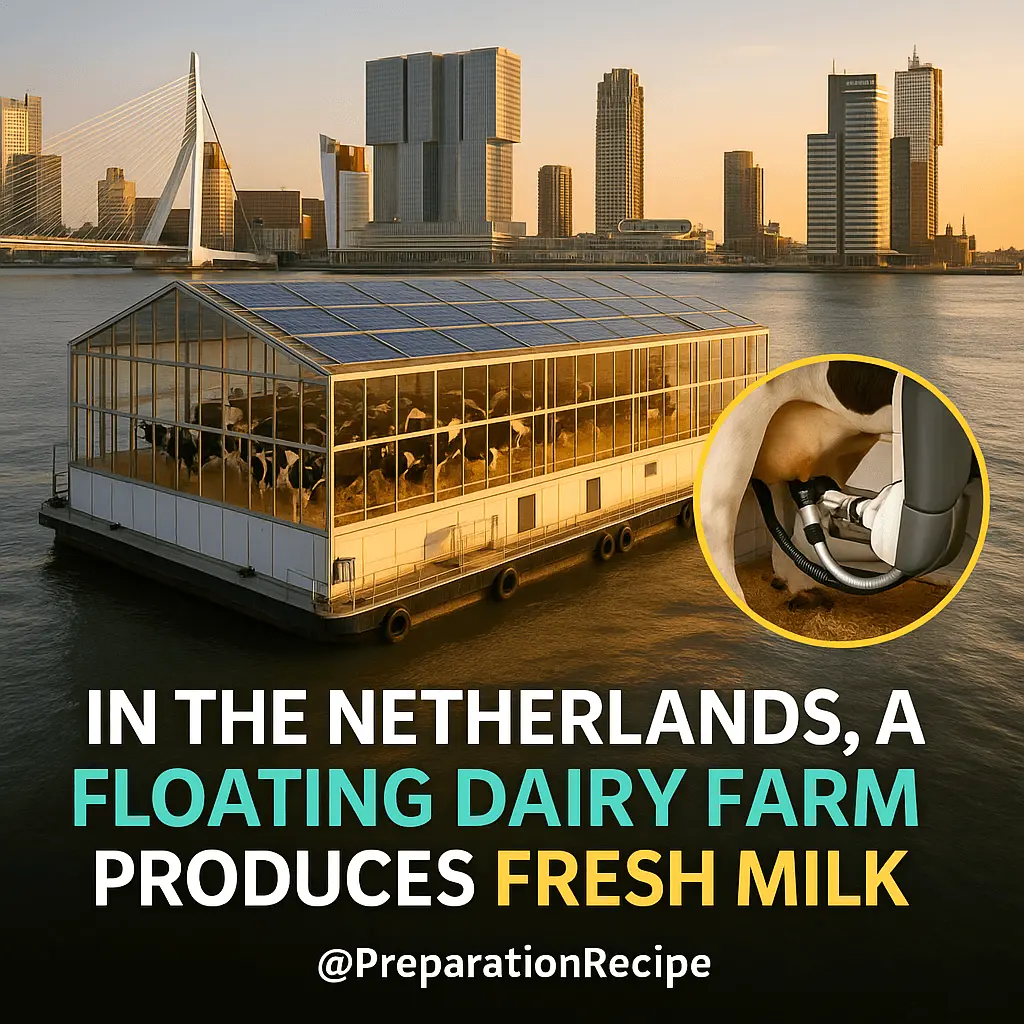
Last week, I saw a photo that completely stopped my scroll – a real dairy farm floating on water. Not on land, not near a field, but smack in the middle of a city harbor. It looked like a sleek houseboat… but with cows. And yes, they were calmly munching hay with the city skyline in the background.
That picture reminded me of a conversation I had with my uncle, who’s a farmer in Pennsylvania. He once joked that one day, cows might end up in skyscrapers with elevators if we run out of space. We both laughed. But now? A floating farm? Maybe he wasn’t that far off.
Let’s explore how this floating dairy works, why it even exists, and what it might mean for the future of the food on our plates -including yours.
1. So Wait – A Farm on the Water?
Yes, really. The world’s first floating dairy farm sits right in Rotterdam, a major city in the Netherlands. It looks like a modern greenhouse bobbing gently on the river. But instead of tomatoes or lettuce, you’ll find about 40 cows living upstairs – with a view of the skyline.
The idea came from a group of Dutch engineers and farmers who wanted to bring food production closer to people – especially in cities where space is tight and farmland is shrinking. With sea levels rising, they figured: why not use the water?
It’s not just clever – it’s peaceful, too. Inside the floating barn, everything is designed to be cow-friendly. There’s fresh bedding, soft lighting, and even a robotic milking system that lets cows choose when they want to be milked. No stress, just calm moo-ing.
2. Why Go Floating in the First Place?
Good question. Turns out, there are a few solid reasons:
First, space. Cities are growing fast, and farmland is disappearing. Building up or on water opens up new options – without cutting down forests or taking land from other farms.
Second, sustainability. This floating farm uses solar panels to power its machines and rainwater to help clean the place. Even cow waste is collected and turned into fertilizer for nearby gardens. It’s kind of like a mini eco-village… just with cows.
And third? Freshness. Milk from this farm is processed and bottled right below the cows – literally one floor down. So the milk you buy in local shops or vending machines in Rotterdam was made practically around the corner, not shipped in from hundreds of miles away.
That’s hard to beat.
3. But Don’t Cows Get Seasick?
I wondered that too. Imagine trying to eat lunch while your floor wobbles slightly. But cows are surprisingly adaptable.
The floating barn is built on a special platform that stays steady, even when boats go by. Engineers made sure the movements are super gentle – like a soft sway rather than a jolt. And cows, once they get used to it, seem totally unbothered.
Actually, some reports suggest they’re calmer than in traditional barns. Maybe it’s the view.
4. What Happens to All That Milk?
Each cow on the farm can give up to 6 gallons of milk a day – that’s a lot of creamy goodness.
After milking, the milk is pasteurized (gently heated to make it safe) right on the lower level of the farm. Then it’s bottled and delivered by electric van or cargo bike to stores nearby. You can even buy it from local vending machines.
Some of the milk is turned into yogurt or cheese. And every bit of waste from the cows – yes, even the smelly kind – is cleaned and reused, either as fertilizer or for energy.
It’s a tight, circular system where nearly nothing goes to waste.
5. Could This Happen in the U.S.?
Actually, it might. Floating farms may sound like a European thing, but the idea solves a lot of problems we also face in the U.S. – urban growth, climate shifts, food transport, and farm sustainability.
Cities like New York, San Francisco, or Miami could benefit from compact, local food systems that float on harbors or rivers. Think fresh milk in the heart of Brooklyn, or lettuce grown right off the docks.
And for coastal areas worried about flooding or saltwater damage, farms on water could be a smart way to keep producing food – no matter what the weather throws at us.
Sure, it takes investment, creativity, and local support. But the potential is real.
6. What This Means for You (and Me)
You might never live near a floating farm – and that’s okay. But these new ideas help remind us that food doesn’t have to come from far away or follow old rules.
When you see milk at the store, you’re often seeing the end of a long journey. Floating farms flip that story. They bring production right to the people. And they do it in a way that respects the animals, the environment, and the city around them.
It makes you wonder: what else could we rethink?
A Fresh Perspective, Right From the Water
I never thought I’d be inspired by cows on a boat. But here we are.
Seeing a floating dairy farm reminded me that innovation doesn’t always look like gadgets and screens. Sometimes, it looks like something familiar – just done in a kinder, smarter way.
Whether it’s a rooftop garden, a city chicken coop, or a floating barn, there’s more than one way to bring food closer to home.
Let’s keep cheering for ideas like this – and maybe one day, we’ll sip a glass of fresh milk knowing it was made just across the river.